How Often Should I Pole Dance? (The Real Answer)
So, you’ve tried pole dancing. And now you’re hooked. The big question hitting your brain is probably, "How often should I do this to get good?" Everybody asks it, but there isn't a magic number.
Your perfect schedule depends entirely on you, your fitness, your goals, and how quickly your body says, "Okay, I'm ready for more." This guide will help you figure that out.
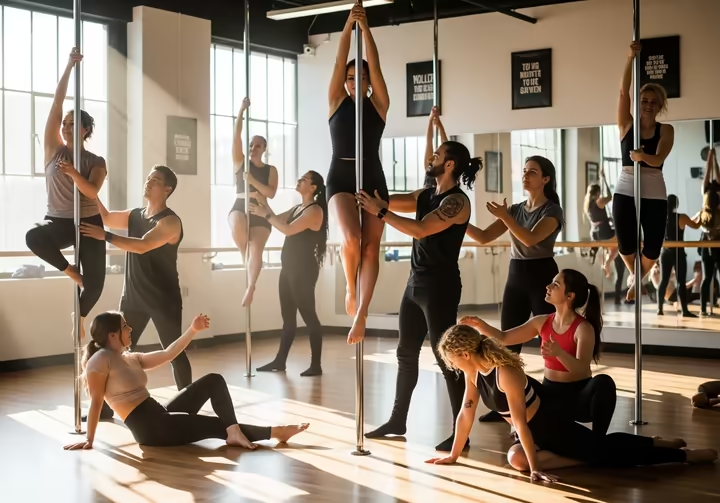
The "Just Starting Out" Phase (1-2 Times a Week)
When you’re brand new, your excitement is sky-high. You want to do it all, right now. But the best advice for any beginner is simple: start slow.
One to two times per week is the way to go. Your body is dealing with a whole new kind of workout, and you need to give it a minute to catch up. Respecting this initial shock is key to a long and happy pole life.
Skin, Muscles, and Grip... Oh My!
First, your skin needs to get tough. Those bruises, or "pole kisses," are your skin learning how to grip. Training too often at the start just leads to pain and makes it hard to hold on at all.
Second, your muscles will be SORE. This is called Delayed Onset Muscle Soreness (DOMS), and it’s a normal part of getting stronger. But your tendons and ligaments adapt much slower than muscles, and rushing this is a classic way to get an overuse injury (hello, shoulder pain).
Finally, your grip strength has to be built from scratch. Your hands will probably be the first thing to give out. Training with a tired grip not only makes it impossible to do moves right, it’s also dangerous.
Quality Over Quantity
So, is once a week really enough? Absolutely. One focused, high-quality class when you're rested is way better than three sloppy sessions when you're tired.
You're building muscle memory, and you want to build good habits from the start. This slow start also teaches you to tell the difference between "good pain" (like a muscle burn) and "bad pain" (like a potential injury). It's a skill you'll need forever.
Leveling Up (2-4 Times a Week)
After a few months, things will start to change. You’ll feel more at home on the pole. This is your body telling you it’s ready for more.
You’ll know you’re ready when your muscle soreness isn’t as bad and doesn't last all week. You might even feel energized after class instead of totally wiped out. These are signs that your body has adapted and can handle a bigger challenge.
Don't Just Do More... Do Different
Bumping your training up to three or four times a week is where you can see some serious progress. But there’s a catch: you can’t just do the same hard workout every time. That’s a fast track to burnout and injury.
The solution is to have different goals for different days. A balanced week ensures you keep getting better without wrecking your body.
- Day 1: Strength & Tricks (new, hard moves)
- Day 2: Flow & Choreography (connecting moves)
- Day 3: Flexibility & Mobility (off-pole stretching)
Your week could include a Strength and Tricks Day , where you work on new, tough moves. Follow that with a lower-intensity Flow and Choreography Day , where you dance and connect moves you already know. Then, add a Flexibility and Mobility Day , which might be off the pole entirely, focusing on stretching and joint health.
Rest Days Are Training Days
It’s easy to think of rest days as wasted time. They’re not. Rest both helps you recover and is a crucial part of your training.
You don't actually get stronger on the pole, you get stronger on the couch afterward. Pole sessions create tiny tears in your muscles. It's during rest that your body repairs them, building them back even stronger.
Passive vs. Active Rest
There are two types of rest. Passive rest is doing nothing, just chilling. Your body needs at least one full day of this per week.
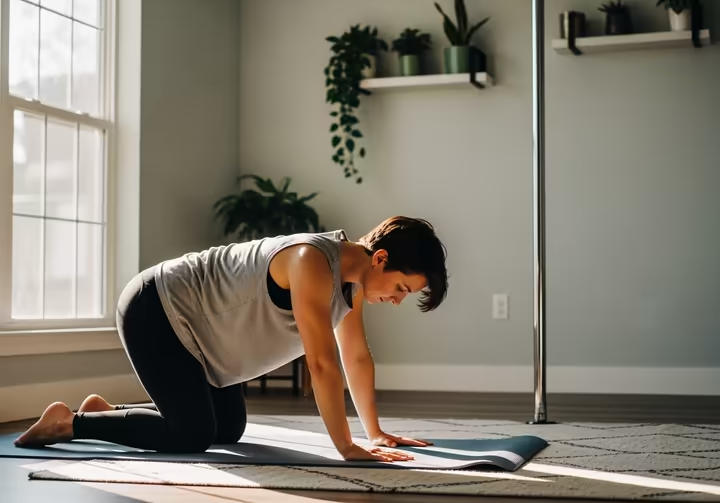
Active recovery is gentle movement on your "off" days. Think taking a walk, going for a swim, or doing some light yoga. This increases blood flow, which helps deliver nutrients to your muscles and clear out the waste products that make you sore.
Listen To Your Body (It's Smarter Than You)
Your most important teacher will always be your own body. Learning to understand its signals is the key to a long and healthy pole journey.
"Good Pain" vs. "Bad Pain"
Muscle soreness (DOMS) is a generalized, dull ache in the muscles you worked. It's a good sign, showing that your body is adapting and getting stronger.
Injury pain is different. It's often sharp, stabbing, or pinching and located in a specific spot, especially a joint like the shoulder or wrist. That pain is your body yelling "STOP!"
Signs You're Overdoing It
Overtraining is real. Key signs include feeling tired all the time, a drop in your performance, or finding that moves you’d mastered suddenly feel impossible. You might also feel grumpy, have trouble sleeping, or get sick more often. These are signals to back off and rest.
A great tool is a training log. Just take a minute after each session to note what you did, how you felt, your soreness level, and how you slept. Over time, you’ll see patterns emerge, like realizing that training three days in a row turns you into a monster.
What's Your "Why"?
You can't figure out how often to train without first asking: "Why do I pole dance?" Your reason for doing it should guide your entire schedule.
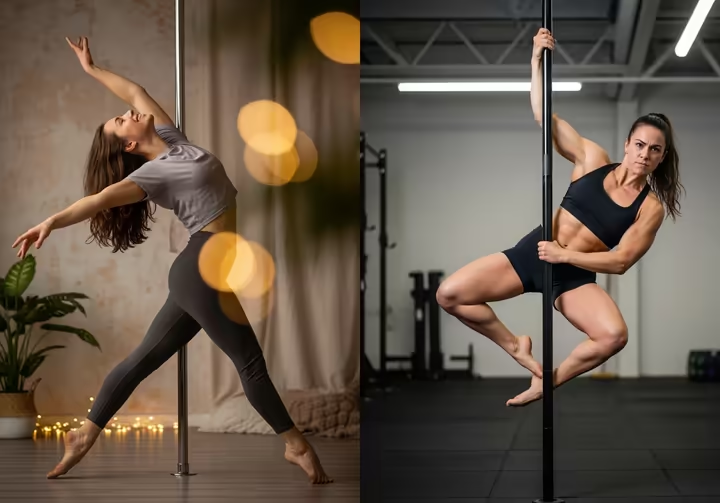
The Hobbyist Poler is here for joy, expression, and fitness. For you, two to three times a week is often the sweet spot. It keeps pole a passion, not a chore.
The Aspiring Athlete dreams of competing or performing. This requires more dedication, probably four, five, or even more planned sessions per week. This path is a big commitment to training, nutrition, and sleep.
A common problem is having an athlete's goals on a hobbyist's schedule. Be honest with yourself about the time and energy you can commit, and set goals that match. This way, you'll have a rewarding journey instead of a frustrating one.
It's Not Just How Often, It's How Hard
The number of days you train is only half the story. The length and intensity of each session matter just as much. A short, focused session is often better than a long, sloppy one.
For most people, a 60-minute session is perfect. This gives you time for a proper 10-15 minute warm-up, 35-40 minutes for the main workout, and a 5-10 minute cool-down with stretching. Don't skip the warm-up or cool-down!
A high-intensity session, like learning a new strength move, is tough on your body and brain. It needs more recovery time, maybe 48 hours or more. A low-intensity session, like practicing flow, is less taxing and you might be ready to go again in 24 hours. Alternating between high and low intensity is the secret to training more often without burning out.
So, What's the Magic Number?
There isn't one. The answer is a process, not a number. You find it by starting slow, listening to your body, and matching your practice to your goals.
It's an ongoing conversation with yourself. Now stop reading, and go have some fun on the pole.
Works cited
- How many times a week should I pole dance?, https://www.milanpoledance.com/blog/how-many-times-should-i-pole-dance
- How often can one train on Pole? - Milan Pole Dance Studio, https://www.milanpoledance.com/blog/how-often-can-one-train-on-pole
- How often should I Pole Dance? - Zero Gravity Contortion, https://www.zerogravitycontortion.com/post/how-often-should-i-pole-dance?lang=en
- How Often Should You Practice Pole Fitness Dancing?, https://polefitnessdancing.com/how-often-should-you-practice-pole-fitness-dancing/
- The Role of Proper Skin Care in Pole Dancing: Tips and Tricks for ..., https://polephysics.com/blog/-the-role-of-proper-skin-care-in-pole-dancing-tips-and-tricks-for-maintaining-healthy-skin/
- 10.6 Exercise and Muscle Performance – Anatomy & Physiology, https://open.oregonstate.education/aandp/chapter/10-6-exercise-and-muscle-performance/
- Is It Just Soreness or an Injury? Understanding DOMS vs. Muscle ..., https://libertybaychiro.com/is-it-just-soreness-or-an-injury-understanding-doms-vs-muscle-strain/
- Beginning pole dancing classes soon, and curious.. How long did it take you to get "good" at it? - Reddit, https://www.reddit.com/r/poledancing/comments/1v5hu5/beginning_pole_dancing_classes_soon_and_curious/
- 6 x tips for a strong split grip! – The Pole PT, https://www.thepolept.com/strength-for-pole/6-x-tips-for-a-strong-split-grip/
- The Complete Guide To Pole Dancing Muscle Injuries, https://lovepolekisses.com/training-safely/pole-dancing-muscle-injuries/
- Injury and Health in Pole Dance (Find Answers) | PolePedia, https://polepedia.com/injuries-and-health/
- Training Tips to Improve Your Grip Strength - Lupit Pole, https://www.lupitpole.com/en/news/pole-dance/training-tips-to-improve-your-grip-strength
- How often do you attend pole classes? : r/poledancing - Reddit, https://www.reddit.com/r/poledancing/comments/1hahr9f/how_often_do_you_attend_pole_classes/
- Is one class a week enough? : r/poledancing - Reddit, https://www.reddit.com/r/poledancing/comments/18f44ow/is_one_class_a_week_enough/
- How to Know the Difference Between Soreness and Pain, https://www.reboundmd.com/news/how-know-difference-between-soreness-pain
- Halp! How do I programme my training for pole? - The Pole PT, https://www.thepolept.com/strength-for-pole/halp-how-do-i-programme-my-training-for-pole/
- How to structure your training for pole winz - The Pole PT, https://www.thepolept.com/strength-for-pole/how-to-structure-your-training-for-pole-winz/
- Muscle Soreness vs Injury: What is DOMS? - Melbourne CBD Physiotherapy, https://melbournecbdphysio.com.au/blog/muscle-soreness-vs-injury-what-is-doms/
- How Long Will It Take Me to Get Good at Pole Dancing? - 123poling, https://123poling.com/Pole-Dance-Knowledge-Base/how-long-will-it-take-me-to-get-good-at-pole-dancing/
- how often should I be pole dancing in a week to make noticeable progress? what helped YOU make noticeable progress? : r/poledancing - Reddit, https://www.reddit.com/r/poledancing/comments/uh3err/how_often_should_i_be_pole_dancing_in_a_week_to/
- Pole Dancing-Specific Muscle Strength: Development and Reliability of a Novel Assessment Protocol - MDPI, https://www.mdpi.com/2409-9279/7/3/44
- Overtraining: What It Is, Symptoms, and Recovery - HSS, https://www.hss.edu/health-library/move-better/overtraining
- How to Build Your Strength for Pole Dance (Free Training Plan) - PoleFreaks, https://www.polefreaks.com/an-introduction-to-strength-training/
- Find Your Flow in Pole Dance - Learn More | PolePedia, https://polepedia.com/find-your-natural-flow/
- 3 powerful Pole Flow techniques: Turn your pole routine into a dance! - The Pole Dancer, https://thepoledancer.com/tutorials/3-pole-flow-techniques-dance-routine/
- Pole conditioning and stretching - what's the ideal schedule - StudioVeena.Com, https://www.studioveena.com/discuss/discussion/Pole_conditioning_and_stretching__whats_the_ideal_schedule_20130813080830/
- (How To) Become More Flexible for Pole Dancing - PolePedia, https://polepedia.com/how-to-become-more-flexible/
- r/poledancing Wiki: Flexibility Training Guide - Reddit, https://www.reddit.com/r/poledancing/wiki/flexibility/
- Muscle Recovery: Physiological Processes & Effective Strategies, https://australiansportsphysio.com/muscle-recovery/
- Skeletal muscle and resistance exercise training; the role of protein synthesis in recovery and remodeling - PMC - PubMed Central, https://pmc.ncbi.nlm.nih.gov/articles/PMC5401959/
- How much rest should you be getting? - Irish Pole Dance Academy, https://irishpoledanceacademy.com/pole-dancing-and-rest/
- The Ultimate Guide to Recovery for Pole & Aerials ..., https://shinefitnessstudio.com/2025/02/17/the-ultimate-guide-to-recovery-for-pole-aerials/
- The Ultimate Guide to Recovery for Pole Dancers - Polisthenics, https://polisthenics.com/the-ultimate-guide-to-recovery-for-pole-dancers/
- Pole Exercises: Yoga Postures for Proper Pole Fitness - Mallakhamb Federation USA, https://www.mallakhambinusa.org/mallakhamb/pole-exercises-yoga-postures-for-proper-pole-fitness/
- Cross-training – two ways to complement your pole dance workout, https://exoticacademy.com/cross-training-for-pole-dancers/
- Why You *Actually* Need to Foam Roll After Pole Workout - Pole Flow Studio YYC, https://poleflowstudioyyc.ca/f/why-you-actually-need-to-foam-roll-after-pole-workout
- Balls to tight shoulders: 20 min self-massage for polers - The Pole PT, https://www.thepolept.com/fitness/balls-to-tight-shoulders-20-min-self-massage-for-polers/
- Overtraining Syndrome/Burnout | Rady Children's Health, https://www.rchsd.org/programs-services/sports-medicine/conditions-treated/overtraining-syndromeburnout/
- Health Tip | Soreness vs Pain: What's the Difference? | Choose PT, https://www.choosept.com/health-tips/soreness-vs-pain-whats-difference
- Are you Overtraining? : Welcome to the International Pole Convention :, https://poleconvention.com/fitness-2/are-you-overtraining/
- Six Physical Signs that Athletes are Overtraining - TrueSport, https://truesport.org/preparation-recovery/six-signs-overtraining/
- Creating a pole training schedule to boost your motivation - Chrome Chronicles, https://chromechroniclespole.com/2021/10/21/creating-a-pole-training-schedule-to-boost-your-motivation/
- How long from starting pole can you get to be competing level? : r/poledancing - Reddit, https://www.reddit.com/r/poledancing/comments/8zlgsg/how_long_from_starting_pole_can_you_get_to_be/
- Pole Dancing and Pole Fitness: What Sets Them Apart? | Achieve ..., https://www.achievepolestudio.com.au/pole-dancing-and-pole-fitness-what-sets-them-apart/
- Pole Dancing for Fitness: The Physiological and Metabolic Demand of a 60-Minute Class, https://pubmed.ncbi.nlm.nih.gov/30507730/
- (PDF) Pole Dancing for Fitness: The Physiological and Metabolic ..., https://www.researchgate.net/publication/329353158_Pole_Dancing_for_Fitness_The_Physiological_and_Metabolic_Demand_of_a_60-Minute_Class
- What Makes a Good Pole Goal? — Essence Pole & Dance Studio, https://www.essencestudiopole.com/blog/what-makes-a-good-pole-goal
- 9 Mistakes That Destroy Your Pole Progress, https://lovepolekisses.com/motivation/mistakes-destroy-pole-progress/
- How to Structure Your Pole Dance Class (Part 1 of 3), https://poleassociation.org/how-to-structure-your-pole-dance-class-part-1-of-3/
- How to get good at Pole dancing? - the rule of three, https://www.evespoleandyoga.co.uk/post/how-to-get-good-at-pole-dancing-the-rule-of-three
- High-Intensity Training vs Low-Intensity Training: What's the Difference, and Why Is It Important in a Successful Training Program? - Reload PT, https://www.reloadpt.com/foundations-of-personal-fitness/high-intensity-training-vs-low-intensity-training-whats-the-difference-and-why-is-it-important-in-a-successful-training-program
- Cardio for pole dancers - The Pole PT, https://www.thepolept.com/cardio/cardio-for-pole-dancers/
- Recovering from pole class : r/poledancing - Reddit, https://www.reddit.com/r/poledancing/comments/1gmgpyt/recovering_from_pole_class/