The Path to the Podium: Pole Sport's Epic Journey Toward the Olympic Games
If you’ve ever tried to lift yourself up on a vertical pole, you know it’s shockingly hard. This mix of strength and art has sparked a global quest, to get pole sport onto the biggest stage of all, the Olympic Games. It’s a story about amazing athletes, a controversial name change, and a whole lot of paperwork.
So, Is It an Olympic Sport?
People always ask, "Is pole dancing an Olympic sport?" The short answer is no, not right now. 1 But the story of why not, and the global movement trying to change that, is a wild ride. The journey starts with a battle over a single word.
The Great Name Debate
The switch from "pole dancing" to "pole sport" wasn't just about words. It was a calculated move to make the discipline sound more like a serious sport and less like performance art.
Everyone knows the term "pole dancing," but it’s tied to its history in burlesque and strip clubs. While many in the community are proud of these roots, it's also seen as the biggest hurdle for getting a thumbs-up from the traditional International Olympic Committee (IOC). 3
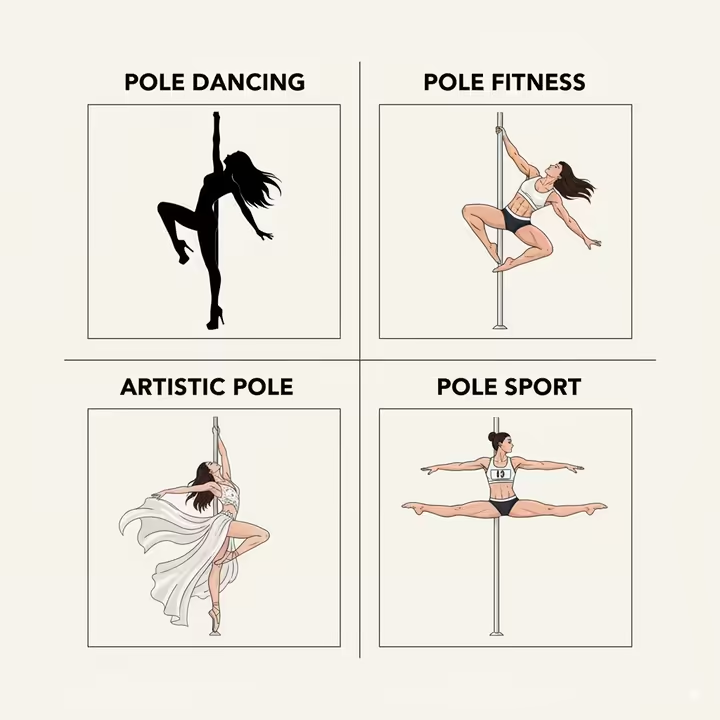
In the early 2000s, "pole fitness" became popular. People like Sheila Kelley pushed pole as a great workout, which helped separate it from a purely sexualized context and got more people into studios. 5
As competitions got more serious, the term "artistic pole" appeared. This style focuses on storytelling and musical expression, sort of a bridge between sport and theater. 8
For the Olympic bid, the International Pole Sports Federation (IPSF) pushed the term "pole sport". 3 They chose the name to sound like gymnastics, focusing on points, scoring, and pure athleticism. It was a "family-friendly" version designed to get rid of the "baggage" of the past. 4
| Term | Primary Focus | Typical Attire | Olympic Context |
|---|---|---|---|
| Pole Dancing | Sensuality, Erotic Art, Entertainment | Heels, Minimal Costuming | The cultural origin, often seen as a barrier to mainstream acceptance. |
| Pole Fitness | Athleticism, Strength Building, Workout | Fitness attire (shorts/top) | The first major step toward mainstreaming the activity as exercise. |
| Artistic Pole | Storytelling, Expression, Dance | Thematic costumes | A competitive discipline, but with less focus on Olympic-style standardization. |
| Pole Sport | Technical Execution, Standardized Scoring | Uniforms/Team Tracksuits | The official term and format developed specifically for the Olympic bid. |
But this rebranding plan backfired a bit. While trying to fix the stigma problem, it created a huge fight inside the community. Many felt that cleaning up the sport's image was a "slap in the face" to the sex workers and entertainers who created the art form. 1
This created a split between "pole dance" purists and "pole sport" athletes. The IOC requires a sport's community to be united under one governing body. 2 If that community can't even agree on its own identity, that’s a big problem for the Olympic bid.
The Long Climb
Pole sport's path to the Olympics is a story of big wins and frustrating steps backward. It started with a few people asking "Why not?" and building a whole organization to make it happen.
It Started with a Question (2006)
The Olympic push really started with one person, Katie Coates. Watching performers in Ibiza, she was blown away by their strength and skill. 2 In 2006, she ran a survey asking the pole community a simple question: should pole be in the Olympics? Over 10,000 people voted yes, and the campaign was born. 3
Building the Bureaucracy (2009)
With that vote of confidence, Coates and Tim Trautman from the USA founded the International Pole Sports Federation (IPSF) in 2009. 4 Their mission was to turn pole into a real, internationally recognized sport. The IPSF created a standardized scoring system, an anti-doping program, and certification for athletes and judges, building a framework that could meet official criteria. 4
Big Steps Forward
The IPSF's hard work started paying off with some major milestones.
- 2012: The first World Pole Sports Championships were held, with 43 athletes from 14 countries competing under the new rules. 12
- 2016: The IPSF became a signatory to the World Anti-Doping Agency (WADA) code, a must-have for any Olympic hopeful. 12
- 2016: Later that year, the IPSF officially applied to the International Olympic Committee for recognition. 4
The Big Breakthrough... And a Bigger Setback (2017-2023)
In October 2017, they had their biggest win yet. The IPSF was granted "Observer Status" by the Global Association of International Sports Federations (GAISF), the main club for all international sports. 1
This was huge, the first official step on the ladder toward the Olympics. It was a sign that GAISF saw pole sport as a real, developing sport, and it gave the community a massive boost of confidence. 25
But the victory was short-lived. Katie Coates later said the status didn't provide much real help, and getting the required 50 national federations recognized was "an impossible task". 2 Then, in 2023, GAISF was suddenly dissolved and replaced by a new organization, SportAccord. 2
With that change, the "observer status" category was completely eliminated. After years of work, pole sport was stripped of its status and sent back to the starting line. Now, the IPSF has to apply to a new body, through a new process, all over again. 2
The Argument for the Arena
Politics aside, the main argument for pole sport in the Olympics is simple, the athletes are incredible. When you look at the physical demands, pole is basically vertical gymnastics. It's a mix of raw strength, crazy flexibility, and amazing acrobatic skill.
Vertical Gymnastics
An elite pole sport routine is one of the toughest athletic performances out there.
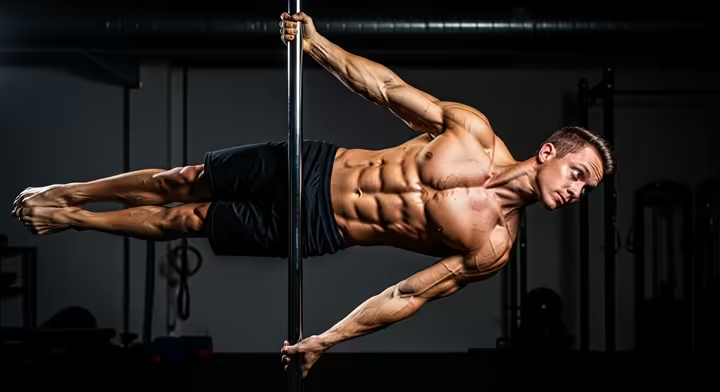
- Strength: It all starts with insane upper body and core strength. Athletes lift and hold their entire body weight, often with just their hands. 6 Moves like the "human flag" are just as powerful as anything you'd see in gymnastics on the rings. 10, 32
- Flexibility: Competitors need the kind of flexibility you see in rhythmic gymnastics or figure skating. Think perfect 180-degree splits ("Jade Split") or extreme backbends ("Rainbow Marchenko"), all while hanging off a pole. 27
- Endurance: A four-minute routine is an all-out sprint. One study found an elite dancer's heart rate hit 96% of its max, with blood lactate levels similar to an elite sprinter's. 33
- Acrobatic Skill: Pole isn't just about holding poses. Routines are full of flips, drops, and mid-air catches, often happening 13 feet in the air with no safety nets. 34
What It Takes to Compete
The life of a top pole athlete is all about dedication, just like any other Olympian. Athletes like world champion Olena Minina or US champion Taylor Dalton follow a brutal training schedule. 10, 36
A typical week involves hours on the pole practicing tricks and routines. Off the pole, they're doing heavy weightlifting, bodyweight conditioning, and long, painful flexibility sessions. 38, 42 And just like any top athlete, rest and recovery days are crucial for muscles to repair and grow. 38
How Do You Even Score This?
To be an Olympic sport, you need objective, clear judging, which is why something like ballet isn't included. 29 The IPSF created a detailed "Code of Points," modeled after the ones used in gymnastics and figure skating, to turn a performance into a number. 4
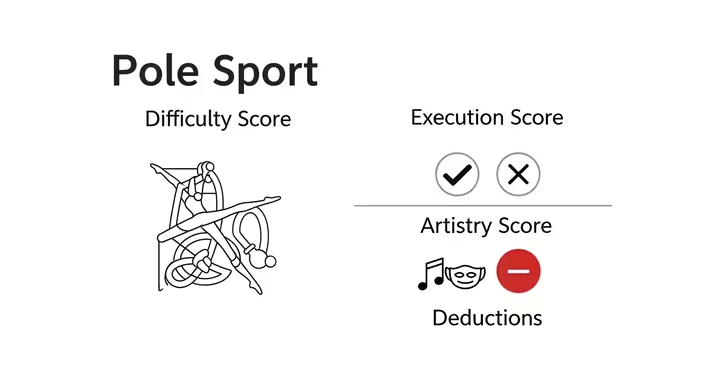
The score is broken into a few parts.
- Difficulty Score: Athletes submit a list of the hard moves they plan to do. Judges watch and give points only for the moves they pull off correctly. 45
- Execution Score: This is all about quality. Judges start with a base score and subtract points for mistakes like bent knees, unpointed toes, or wobbles. 45
- Artistry Score: This part is a bit more subjective. It rewards choreography, musicality, and stage presence. 45
- Bonuses and Deductions: Athletes can get bonus points for linking hard moves together. The Head Judge can also subtract points for breaking rules, like if the music is too long. 45
This rigid system is necessary to get the IOC's approval. But it also creates a problem, it can force athletes to build routines around scoring points instead of creative expression. 50 The tool designed to open the Olympic door is seen by some as a cage for the sport's artistic soul.
The Headwinds
Even with amazing athletes and a rulebook, pole sport faces some big obstacles. The biggest is the historical stigma attached to pole dancing. And that external problem is matched by a huge internal fight over the sport's identity.
The Stigma Problem
You can't talk about the Olympic bid without acknowledging that modern pole dancing grew out of strip clubs and burlesque shows. 3 This history gives the buttoned-up world of international sport a major perception problem.
For organizations like the IOC, the connection to erotic entertainment is hard to ignore. This often leads to the sport being dismissed as "raunchy" instead of being seen as athletic. 2 The stigma makes it hard to get media coverage, sponsorships, and government funding, which is why the "pole sport" rebranding happened in the first place. 3
Art vs. Sport: The Fight Within
While some are fighting for Olympic acceptance, many inside the pole community aren't sure they even want it. They're afraid of what might be lost if pole goes mainstream.
The main arguments against the Olympics are about protecting pole's unique culture.
- Fear of Sanitization: Many worry the Olympics would strip away the sensual and expressive elements to make it "family-friendly". 1 They fear the official Olympic style would delegitimize the more artistic and exotic forms of pole. 50
- Erasure of Origins: Others feel that rebranding is disrespectful to the sex workers and strippers who created the art form. They argue that building legitimacy by shaming the sport's pioneers is wrong. 3
- Loss of Inclusivity: Pole studios are known as safe, welcoming spaces for adults of all shapes and sizes. 1 The fear is that the Olympics would turn these studios into hyper-competitive gyms focused on training kids, pushing out the adult community that is the sport's backbone. 1
- The Gymnast Invasion: A practical concern is that if pole became an Olympic sport, elite gymnasts would just switch over and dominate, pushing out the athletes who built the sport from the ground up. 1
This internal fight isn't the same everywhere. In countries like Russia, China, and in Latin America, pole was more readily accepted as a gymnastic sport from the start. 3 The battle against stigma is most intense in Western countries like the US and UK.
This might be a generational thing. Many who found pole as adults see it as a form of counter-cultural expression. 1 But a new generation, especially in Eastern Europe, is growing up learning only "pole sport" in a gymnastics-style setting. 10 The challenge for the IPSF is to create a single identity for the IOC that somehow honors both of these worlds.
What Olympic Pole Would Look Like
So what would pole sport at the Olympics actually look like? Based on the rules already set by the IPSF for its world championships, we have a pretty clear picture. It would be a show of strength, precision, and artistry with very strict rules.
The Stage
The competition would happen on a special stage. The main feature would be two vertical poles, each about 13 feet tall and set 10 feet apart. 45 One pole would be static (fixed in place), while the other would be on spin mode, rotating freely to allow for fluid, spiraling moves. 45
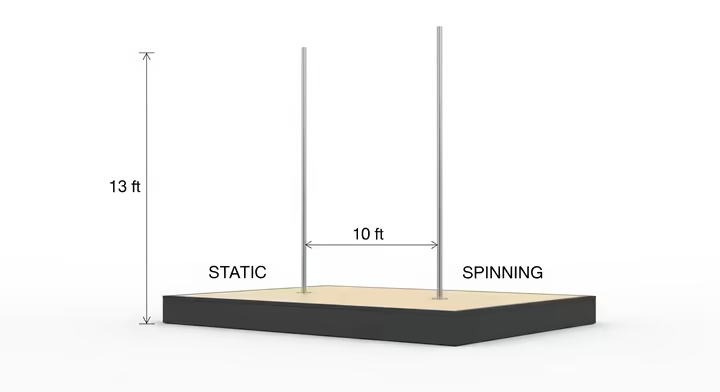
The poles themselves would be a standard 45mm thick, made of materials like chrome or brass. All equipment would be certified by the federation to make sure it's safe and fair for everyone. 4
The Events
An Olympic pole event could have a few different disciplines, just like swimming has different strokes. 61
- Pole Sport: This would be the main event. It’s the most gymnastics-like version, with four-minute routines judged strictly by the Code of Points. 43, 45
- Artistic Pole: This would be more like ice dancing. The focus is on performance, storytelling, and musicality, with fewer compulsory moves and more creative freedom. 8
- Ultra Pole: This would be a fun, modern event. Two athletes would "battle" head-to-head in short, explosive rounds, showing off their best tricks until a winner is declared. 8
Inside a Routine
A four-minute Olympic Pole Sport routine would be a non-stop display of skill. Athletes would perform a choreographed sequence to music, using both the static and spinning poles equally. 45 The routine would need to include a balanced mix of strength holds (like a human flag), dynamic moves (flips and drops), flexibility poses, and spins. 48 To keep the action in the air, athletes can spend no more than 40 seconds on the floor. 49
The Judges
To get the objective scoring the Olympics requires, a big panel of specialized judges would be needed. A typical panel might have nine to thirteen judges, each with a specific job. 45
- Difficulty Judges: These judges check off the high-value moves from a pre-submitted list, making sure they’re done correctly. 45
- Execution and Artistic Judges: This group scores the overall quality, taking away points for mistakes like sloppy lines or bad form. They also award points for choreography and musicality. 45
- Head Judge: This judge oversees everything, settles disagreements, and applies final penalties for any rule-breaking. 45 This whole system is designed to make the competition as fair and credible as possible. 65
So, Where Are We Now?
After all the hard work, where does the Olympic dream stand? The reality is a mix of frustrating setbacks and a community that’s as determined as ever. The story isn't over yet.
Basically, Back to Square One
The biggest recent problem was a bureaucratic one. In 2023, the organization that granted the IPSF its hard-won observer status (GAISF) was dissolved. 2 Just like that, the observer status, the foundation of their progress, was gone.
This forced the IPSF back to the start. The new path to recognition goes through a different group called the Alliance of Independent Recognised Members of Sports (AIMS). Getting into AIMS is the new first step, but the process is still unclear, leaving the IPSF feeling "left hanging." 2
So right now, pole sport has no formal standing with the IOC. While it’s still recognized by the World Anti-Doping Agency, it has to begin the long journey to recognition all over again. 67
When Could It Happen?
With this reset, any chance of getting into the Olympics soon is gone.
- The lineups for Paris 2024 and Los Angeles 2028 are already set. Pole sport wasn't in the running for the new sports (like flag football and squash) added for LA. 29
- The absolute earliest, and still very unlikely, target would be the Brisbane 2032 Games. Getting a new sport approved can take a decade, so even 2032 is a long shot. 22
What Needs to Happen Next
For pole sport to move forward, the IPSF has a few huge tasks ahead of it.
- Get AIMS Membership: The first and most important job is to get accepted by the new AIMS organization. 2
- Grow National Federations: The IPSF needs to prove the sport is popular worldwide. That means growing from its current 25+ recognized national federations to the goal of 50, spread across at least three continents. 2
- Keep Pushing: The community has to keep educating the public, the media, and sports officials about the sport’s athleticism to fight the old stigma. 17
Why It Matters
If pole sport ever makes it to the Olympics, the effect would be huge.
- For Elite Athletes: Olympic status would mean government funding, sponsorships, better training facilities, and global recognition for their life's work. 17
- For the Beginner in the Studio: For the average person taking a class, Olympic inclusion would be a huge validation. It would help legitimize their hobby to skeptical friends and family, and an explosion in popularity would mean more studios, more teachers, and a bigger community. 31
A Dream Worth Chasing?
The path to the podium is long and messy, and it’s possible pole sport will never be an Olympic event. But the journey itself has already done so much. The Olympic dream has professionalized a global sport and pushed athletes to new heights.
Most importantly, it has started a global conversation about what counts as a sport, what counts as art, and how a community honors its past while building its future. Every person who steps into a studio and finds their own strength is part of that journey. And that’s a win all by itself.
Works cited
- Hi from a journalist: What's your view of pole being included in the Olympics? - Reddit, https://www.reddit.com/r/poledancing/comments/1b777rc/hi_from_a_journalist_whats_your_view_of_pole/
- Paris Olympics 2024: Why won't the Games let pole dancing become a sport?, https://slate.com/culture/2024/07/olympics-2024-paris-summer-usa-skateboarding-pole-dance.html
- Pole Dancing: Road to the Olympics - The Pangean, https://thepangean.com/Pole-Dancing-Road-to-the-Olympics
- Pole dance - Wikipedia, https://en.wikipedia.org/wiki/Pole_dance
- (Learn) The Origin and History of Pole Dancing - PolePedia, https://polepedia.com/origin-history-pole-dancing/
- What is Pole? Pole Fitness & Pole Sports at TRIX DXB, https://trixdxb.com/pole-fitness-and-sports
- Pole dancing pushes bid as Olympic sport - CBS News, https://www.cbsnews.com/news/pole-dancing-pushes-bid-as-olympic-sport/
- Pole Dancing Styles - Exotic Dance Academy, https://exoticacademy.com/pole-dancing-styles/
- Decoding Pole: Artistry vs. Athleticism - AK Pole Studio, https://www.akpolestudio.com/post/decoding-pole-artistry-vs-athleticism
- The Olympics of Pole Sports - Jejune Magazine, https://www.jejunemagazine.com/home/pole-sports
- Artistic Pole - International Pole and Aerial Sports Federation, https://ipsfsports.org/en/about-us/ipsf/ipsf-disciplines/artistic-pole
- The History of Pole and Aerial Sports, https://ipsfsports.org/en/about-us/about-the-federation/history-of-pole-and-aerial-sports
- Pole sports, pole dance, pole fitness, the differences?, https://www.swisspolesportsfederation.com/wp-content/uploads/2020/01/2020.01.09-Pre%CC%81sentation-pole-sports_EN.pdf
- www.sfchronicle.com, https://www.sfchronicle.com/sports/article/pole-dancing-olympic-sport-19621670.php#:~:text=The%20IPSF%20has%20worked%20to,losing%20observer%20status%20last%20year.
- Those Against Pole Becoming An Olympic Sport...Why? : r ... - Reddit, https://www.reddit.com/r/poledancing/comments/7z882a/those_against_pole_becoming_an_olympic_sportwhy/
- Olympics-Pole dancers eyeing Games participation, but soul of sport at risk - KFGO, https://kfgo.com/2024/04/04/olympics-pole-dancers-eyeing-games-participation-but-soul-of-sport-at-risk/
- Manifesting Pole Dance as an Olympic Sport I Lupit pole, https://www.lupitpole.com/index.php/en/news/pole-dance/manifesting-pole-dance-as-an-olympic-discipline
- Pole sports - Wikipedia, https://en.wikipedia.org/wiki/Pole_sports
- International Pole Sports Federation - Wikipedia, https://en.wikipedia.org/wiki/International_Pole_Sports_Federation
- International Pole Sports Federation (IPSF), https://www.swisspolesportsfederation.com/home/ipsf-ipsaf/?lang=en
- About Us - International Pole Sports Federation, http://www.polesports.org/about-us/
- Could Pole Dance Become an Olympic Sport? - fitqs, https://www.fitqs.com/post/could-pole-dance-become-an-olympic-sport
- Pole dancers eyeing Olympic participation | RNZ News, https://www.rnz.co.nz/news/national/513480/pole-dancers-eyeing-olympic-participation
- Pole Sports: Considering Stigma - ResearchGate, https://www.researchgate.net/publication/347877226_Pole_Sports_Considering_Stigma
- What is GAISF? - World Combat Games - SportAccord, https://www.worldcombatgames.sport/what-is-gaisf/
- Information: GAISF Observer Status | DAPF, https://www.dapf.nl/wp-content/uploads/2020/10/GAISF_20.04.15_Information-GAISF-Observer-Status.pdf
- 7 surprising health benefits of pole dancing - Insure4Sport Blog, https://www.insure4sport.co.uk/blog/benefits-of-pole-dancing/
- The Physical & Emotional Benefits of Pole - Sheer Inspiration Pole Fitness, http://www.sheerinspirationpolefitness.com/the-physical--emotional-benefits-of-pole.html
- If Break is Allowed into the Olympics, Why isn't Pole Dance / Pole Sports? - Reddit, https://www.reddit.com/r/olympics/comments/1ep6qn8/if_break_is_allowed_into_the_olympics_why_isnt/
- Should pole dancing be an Olympic sport? - PoleActive, https://www.poleactive.com/blogs/news/should-pole-dancing-be-an-olympic-sport
- Is Pole Dance a Sport or Not? Here's What You Need to Know - Spincess, https://spincess.store/blogs/information/is-pole-dance-a-sport-or-not-here-s-what-you-need-to-know
- Pole Dancing-Specific Muscle Strength: Development and Reliability of a Novel Assessment Protocol - PMC, https://pmc.ncbi.nlm.nih.gov/articles/PMC11163365/
- Physical and physiological demands in women pole dance: a single ..., https://pubmed.ncbi.nlm.nih.gov/26842868/
- Pole at the Olympics - Pole Championship Series, https://polechampionshipseries.com/pages/pole-at-the-olympics
- (PDF) Special physical fitness factors of athletes involved in pole sports - ResearchGate, https://www.researchgate.net/publication/366318814_Special_physical_fitness_factors_of_athletes_involved_in_pole_sports
- Philology and pole sport - interview with Olena Minina - Rúdvilág.hu, https://www.rudvilag.hu/en/pole-dance-magazine/philology-and-pole-sport---interview-with-olena-minina
- pole — Blogs - Jejune Magazine, https://www.jejunemagazine.com/home/tag/pole
- How to get REALLY good?? : r/poledancing - Reddit, https://www.reddit.com/r/poledancing/comments/1h5l6h0/how_to_get_really_good/
- What's the best cross training for pole? : r/poledancing - Reddit, https://www.reddit.com/r/poledancing/comments/1cwaz53/whats_the_best_cross_training_for_pole/
- How to Build Your Strength for Pole Dance (Free Training Plan) - PoleFreaks, https://www.polefreaks.com/an-introduction-to-strength-training/
- How to design a training programme to be a better pole dancer ..., https://www.thepolept.com/fitness/how-to-design-a-training-programme-to-be-a-better-pole-dancer/
- Pole conditioning and stretching - what's the ideal schedule - StudioVeena.Com, https://www.studioveena.com/discuss/discussion/Pole_conditioning_and_stretching__whats_the_ideal_schedule_20130813080830/
- IPSF News - International Pole and Aerial Sports Federation, https://ipsfsports.org/en/about-us/ipsf/ipsf-disciplines/pole-sports
- Scoring System - U.S. Figure Skating, https://www.usfigureskating.org/about/scoring-system
- POSA Pole Sport Code of Points (2025), https://uspsfcompetitions.com/polesport
- International Pole and Aerial Sports Federation Code of Points – Mid-Cycle Update Aerial Hoop Sports & Aerial Pole Sports Appendix 2025, https://ipsfsports.org/downloads/Uncategorised/ipsf_code_of_points__mid-cycle_update_2025_25022024.pdf
- International Pole Sports Federation Competitions / Championships Code of Points, http://www.swisspolesportsfederation.com/wp-content/uploads/2014/08/Code-of-Points-2014.pdf
- International Pole and Aerial Sports Federation Code of Points – Mid-Cycle Update Appendix 2023, https://www.polesportitalia.org/docs/2023/modulistica_ita_psi/Aggiornamento_Generale_Regole_IPSF_Gennaio_2023.pdf
- International Pole and Aerial Sports Federation Code of Points – Mid-Cycle Update Appendix 2024, https://www.polesportsro.org/documente/2024/IPSF%20Code%20of%20Points%20%20Mid-Cycle%20Update%202024_11122023.pdf
- Should Pole Dance be in the Olympics? - Positive Spin Pole Dance ..., https://positivespinpoledance.com/should-pole-dance-be-in-the-olympics/
- The History of Pole Dance: From Tradition to Modern Sport - Lupit Pole, https://www.lupitpole.com/en/news/pole-dance/history-of-pole-dance
- Sliding Up and Down a Golden Glory Pole : Pole Dancing and the Olympic Games-Bohrium, https://www.bohrium.com/paper-details/sliding-up-and-down-a-golden-glory-pole-pole-dancing-and-the-olympic-games/812638286899052544-98737
- Pole Dance in the Olympics - Rowena Gander, https://www.rowenagander.com/2021/02/pole-dance-in-the-olympics/
- Pole dancing seeks Olympic inclusion | The Independent, https://www.independent.co.uk/sport/olympics/pole-dancing-seeks-olympic-inclusion-1907036.html
- Navigating Controversies and Celebrating Diversity in the World of Pole Dance, https://www.bookeeapp.com/articles/9-controversial-opinions-on-pole-dance-a-deep-dive-into-the-pole-communitys-perspectives
- Is Pole Dancing a Sport? (Should It Be?) | PolePedia, https://polepedia.com/is-pole-dancing-a-sport/
- International Pole and Aerial Sports Federation Apparatus Norms ..., https://ipsfsports.org/downloads/Uncategorised/ipsf_apparatus_norms_2025_06032025.pdf
- IPSF Documents & Policies - International Pole and Aerial Sports Federation, https://ipsfsports.org/en/about-us/ipsf/ipsf-documents-policies
- Lupit Competition Pole – IPSF Certified Professional Pole, https://www.lupitpole.com/en/shop/competition-poles-2
- Lupit IPSF competition pole, brass, 45mm, https://www.lupitpole.com/en/product/lupit-pole-competition-brass-ipsf-45-mm
- Pole & Aerial Sports includes 9 disciplines – Swiss Pole Sports ..., https://www.swisspolesportsfederation.com/home/pole-sports/?lang=en
- IPSF (International Pole Sport and Aerial Federation) Competition Rules : r/poledancing, https://www.reddit.com/r/poledancing/comments/t1uspw/ipsf_international_pole_sport_and_aerial/
- What are the types of pole dancing? - Spinning Wild, https://www.spinningwild.com/blog/what-are-the-types-of-pole-dancing/
- International Pole Sports Federation Artistic Championships Pole ..., https://ipsfsports.org/downloads/Uncategorised/ipsf_artistic_scoring_and_rules_2025_final_25042024.pdf
- INTERNATIONAL POLE SPORTS FEDERATION CODE OF CONDUCT For SPORTING OFFICIALS, http://www.polesports.org/app/download/26301526/Code+of+conduct+for+sporting+officials.pdf
- International Recognition | International Practical Shooting Confederation - IPSC, https://www.ipsc.org/international-recognition/
- List of international sports federations - Wikipedia, https://en.wikipedia.org/wiki/List_of_international_sports_federations
- International Sports Federations (IFs) with Olympic Recognition, https://www.olympics.com/ioc/international-federations
- International Sports Federations Recognized by the IOC - Olympics.com, https://www.olympics.com/ioc/recognised-international-federations
- 2028 Los Angeles Olympics schedule: Dates, locations for every event three years ahead of the Opening Ceremony - CBSSports.com, https://www.cbssports.com/olympics/news/2028-los-angeles-olympics-schedule-dates-locations-for-every-event-three-years-ahead-of-the-opening-ceremony/
- LA28 Releases First Look at Competition Schedule in Celebration of Marking Three Years Out from the 2028 Olympic Games, https://la28.org/en/newsroom/la28-releases-competition-schedule-for-2028-olympic-games.html
- LA28 reveals first version of detailed competition calendar with three years to go until the 2028 Olympic Games, https://www.olympics.com/en/news/la28-reveals-first-version-detailed-competition-calendar-three-years-to-go